
If you visited topcontent.com this week, you probably didn’t notice anything new. That was the point. The site looks the same, says the same things and lives at the same addresses. Underneath, almost everything has changed.
We write about SEO for a living, so we have told plenty of clients that page speed matters. It was time to take our own advice.
Where we started
Topcontent.com had run on WordPress for years. Page builder, translation plugin, a handful of other plugins, six languages and more than a thousand pages. It worked, but it had become heavy. Every visit made the server build the page from a database, and every page pulled in close to 80 files and about a megabyte of data before it was done.

This is what Google PageSpeed Insights said about our home page on desktop on the morning of 17 November:
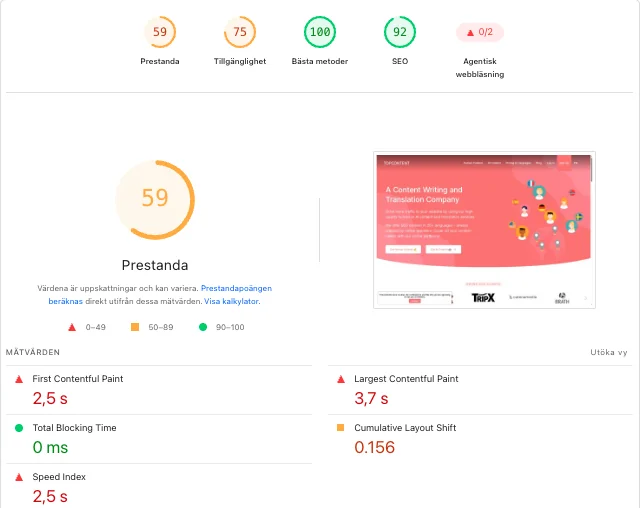
A performance score of 59. It took 2.5 seconds before anything showed up and 3.7 seconds before the main image was in place. The page also jumped around while it loaded, which is what the layout shift number of 0.156 measures. On mobile, the score was 55.

What we did
We replaced WordPress with a static site. Every page is now built once, as a plain HTML file, and the server just hands that file over. There’s no database to ask and no PHP running on each visit.
The rules we set for ourselves were simple:
- Keep everything. Every page that people still read stayed, in all six languages, with the same text and the same design.
- Keep every address. We went through all the old URLs, about 1,800 of them. Pages that still mattered kept their address. Old and unused pages now redirect to the closest relevant page, so no visitor and no search engine hits a dead end.
- Then make it fast.

Making it fast came down to a handful of fairly unglamorous fixes:
- Fonts from our own server. Our typeface used to load from Google Fonts, which meant the browser had to stop and fetch it from a second place before it could show any text. Now it comes along with the rest of the page.
- A smaller icon font. We used to load an 82 KB icon font to show three payment logos in the footer. The new file is 1.5 KB.
- Images in the right size. Every image now comes in several sizes, and a phone gets the small one instead of a desktop-sized picture it has to shrink.
- No more jumping. Every image now tells the browser its size in advance, so the layout stays still while the page loads.
- Compression and caching. Text files are compressed on the way out, and files that never change are cached by the browser for a year. A second visit loads almost nothing.

The result
Here is the same test a few hours later:
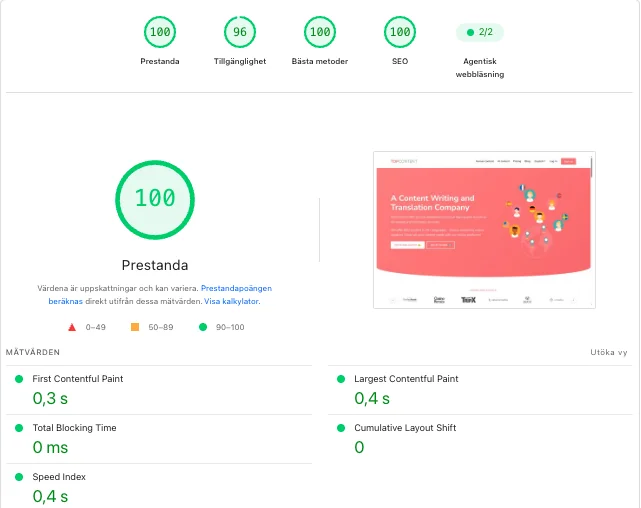
| Desktop | Before | After |
|---|---|---|
| Performance score | 59 | 100 |
| First contentful paint | 2.5 s | 0.3 s |
| Largest contentful paint | 3.7 s | 0.4 s |
| Speed index | 2.5 s | 0.4 s |
| Layout shift | 0.156 | 0 |
| Accessibility | 75 | 96 |
| SEO | 92 | 100 |
On mobile, the score went from 55 to 93 with the move alone, and in our own tests the tuning afterwards took it to 100. The home page now weighs around 100 KB instead of a megabyte, and our server answers in under a tenth of a second where WordPress often needed one and a half.

If you run the test yourself, one box at the top of the report still says “not passed”: the Core Web Vitals assessment. That part is real-world data from Chrome users over the last 28 days, so it still mostly reflects the old site. It should catch up over the coming weeks.
Why we bothered
A fast site is nicer to use, and that alone would have been reason enough. But it also matters for search. Google uses page experience as a ranking signal, and a slow page loses visitors before they have read a single word. Most of our readers find us through search, many of them on their phones, so every second counts.
And the content is still the most important part. Speed won’t save a weak article, but it gives a good one a fair chance to be read.
If you are thinking about doing the same with your own site, or you want content that’s worth loading quickly, get in touch.